What Changed-and Why It Matters
Figma opened a Bengaluru office and started hiring locally to deepen ties with India’s massive developer community and speed enterprise adoption beyond design teams. India is already Figma’s second‑largest user base, and it’s driving usage of new developer‑oriented features like Dev Mode and Figma Make, which has produced 800,000 prototypes in the country to date. For operators, this move signals a push to convert design‑centric workflows into integrated design‑to‑code production pipelines-potentially reducing handoff time and tool sprawl if the code quality and governance keep pace.
Key Takeaways
- Figma is localizing in India to accelerate developer adoption and enterprise sales cycles; 85% of its usage is international, with India second only to the U.S.
- Developer push is real: 40% of Figma’s global users are developers; India is the largest market for Figma Make with 800k AI‑generated prototypes.
- Enterprise traction: Over 40% of the BSE 100 are customers; local presence should tighten feedback loops on code export and Dev Mode features.
- Competitive angle: Figma now competes with Adobe/Canva for design and with Replit/Lovable (AI code) and Zeplin/Anima (handoff) for dev workflows.
- Risks: AI‑generated code quality, IP/licensing uncertainty, vendor lock‑in, and India’s data protection compliance obligations (DPDP) require guardrails.
Breaking Down the Announcement
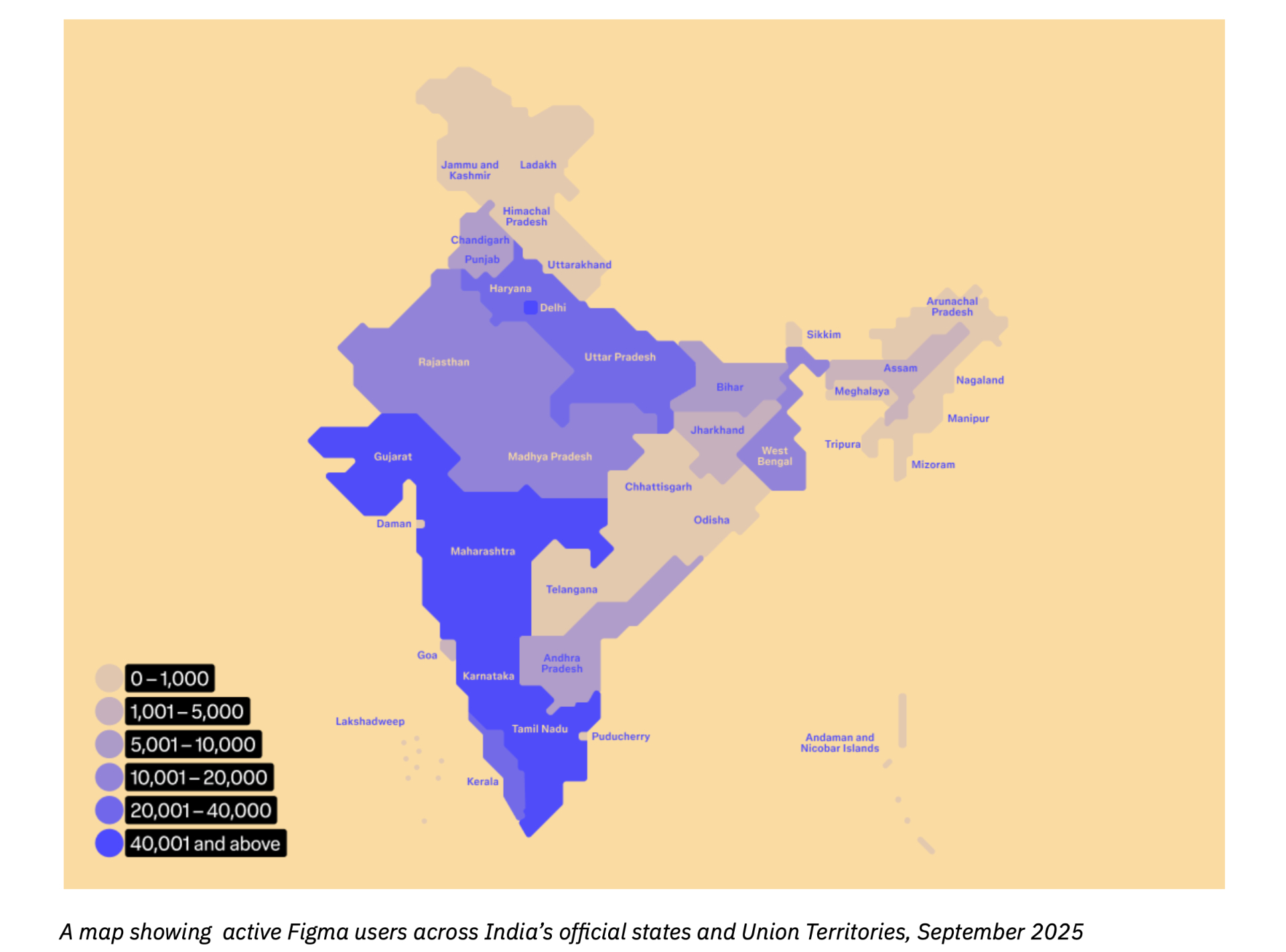
Figma now counts 13 million weekly active users, with India described as “a very large portion” and community membership at 25,000+. The company says it serves users in 85% of India’s 28 states and is already standard at consumer and IT services leaders including CRED, Swiggy, Zomato, Infosys, TCS, Airtel, and Myntra. Until now, India was supported remotely via Singapore; the Bengaluru office will initially focus on sales and marketing, with the clear objective of tightening product feedback and expanding developer adoption.
Two products anchor the developer pitch. Dev Mode (launched in 2023) aims to translate designs into developer‑ready specifications, while Figma Make (introduced in May) uses natural language to generate working web app prototypes inside Figma’s collaborative workspace. India leads global usage of Make; feedback from Indian customers has already influenced improved code‑export quality, according to Figma’s VP of Engineering.
Why Now-and the Competitive Context
India is one of the largest pools of developers—Microsoft cites nearly 22 million Indian developers on GitHub—which makes it a natural beachhead for any design‑to‑code strategy. Figma’s timing aligns with widespread experimentation in AI‑assisted coding and growing pressure to shorten build cycles. The company now straddles multiple competitive fronts: Adobe and Canva on design, Zeplin/Anima/Locofy on handoff, and AI coding platforms like Replit and Lovable on generation. Figma’s differentiator is a unified workspace where design, prototyping, and code live together; the open question is whether its generated code and Dev Mode outputs consistently meet enterprise standards for maintainability, security, and performance.
What This Changes for Operators
If you run product and engineering in India—or rely on Indian teams globally—expect faster cycles on product feedback, localized events and enablement, and more aggressive enterprise outreach from Figma. Teams that already use Figma for design can pilot Make and Dev Mode to test whether they reduce handoff friction and time‑to‑prototype. A realistic expectation: quicker early prototypes and clearer specs; a cautious expectation: generated code still needs review, refactoring, and integration with your design system, CI/CD, and security pipelines.
Procurement may get easier with on‑the‑ground support and local references, but governance work doesn’t go away. Enterprises should validate data handling and cross‑border transfer practices against India’s Digital Personal Data Protection (DPDP) Act requirements, confirm SSO/SCIM, audit logs, and DLP controls, and assess whether AI features are covered by contract terms for IP, indemnity, and model usage.
Risks and Caveats
- AI code quality and security: Generated prototypes can introduce vulnerabilities or anti‑patterns; mandatory code review, SAST/DAST, and SBOM generation are essential.
- IP and licensing: Clarify ownership and licensing of AI‑generated code in your MSA/DPA; ensure third‑party code usage is disclosed and governed.
- Vendor lock‑in: Consolidating design and code in one platform increases switching costs; keep design tokens, components, and assets exportable and versioned in your own repos.
- Integration gaps: Ensure Dev Mode outputs align with your frameworks (React/Next.js, design tokens, Storybook) and don’t fork your design system.
- Adoption reality: Many Indian developers still view Figma as “for designers”; expect an enablement ramp before gains show in cycle time and defect rates.
Recommendations
- Run a 90‑day pilot: One cross‑functional squad using Figma Dev Mode and Make. Measure design‑to‑PR cycle time, rework rate, and handoff defects vs. your baseline.
- Set AI guardrails: Define policy for AI‑generated code (review gates, license scanning, SAST/DAST, secrets detection). Route all output through your CI/CD and security controls.
- Protect portability: Store design tokens, component libraries, and generated code in GitHub/GitLab with clear versioning. Maintain a migration path to Storybook and your framework of choice.
- Close governance gaps: Align contracts with DPDP obligations, confirm SSO/SCIM and audit logging, and require transparency on model usage and data retention for AI features.
Bottom line: Figma’s India bet is a calculated move to convert a design staple into a developer platform. If your teams are already deep in Figma, this is the right moment to test whether Make and Dev Mode meaningfully compress your build cycles—while putting the necessary security, IP, and portability guardrails in place.
Leave a Reply