Executive Summary
Exowatt raised a $50 million extension to its April Series A to scale production of P3, a shipping-container-sized concentrated solar thermal unit that stores heat for up to five days and drives a Stirling-engine generator. The company’s thesis: at around one million units per year, learning-curve manufacturing can deliver firm, 24/7 electricity near $0.01/kWh in sunny regions-potentially resetting data center power costs and siting strategies.
This matters because hyperscale AI campuses (50-300 MW) face grid congestion, rising power prices (often 7-15¢/kWh for 24/7 clean portfolios), and 24/7 carbon-free energy targets. If Exowatt’s economics hold, operators could shave double‑digit percentages off TCO and de-risk interconnection timelines. But unit economics, land intensity, and reliability will decide whether this is a breakthrough or a niche.
Key Takeaways
- Funding: $50M extension (following a $70M April Series A) to ramp P3 production; prior backers include a16z and Sam Altman.
- Product: Modular solar-thermal “rocks in a box” with Stirling generator; up to five days of thermal retention for round-the-clock output.
- Claims: Cost target of ~$0.01/kWh at ~1M units/year; “on par with PV and slightly better than PV+Li-ion” efficiency, per the company.
- Market fit: Strongest in high-DNI, land-abundant regions; behind-the-meter at greenfield data centers.
- Risks: Land and unit count scale, Stirling engine O&M, optical cleaning, interconnection and permitting, and unproven field performance at scale.
Breaking Down the Announcement
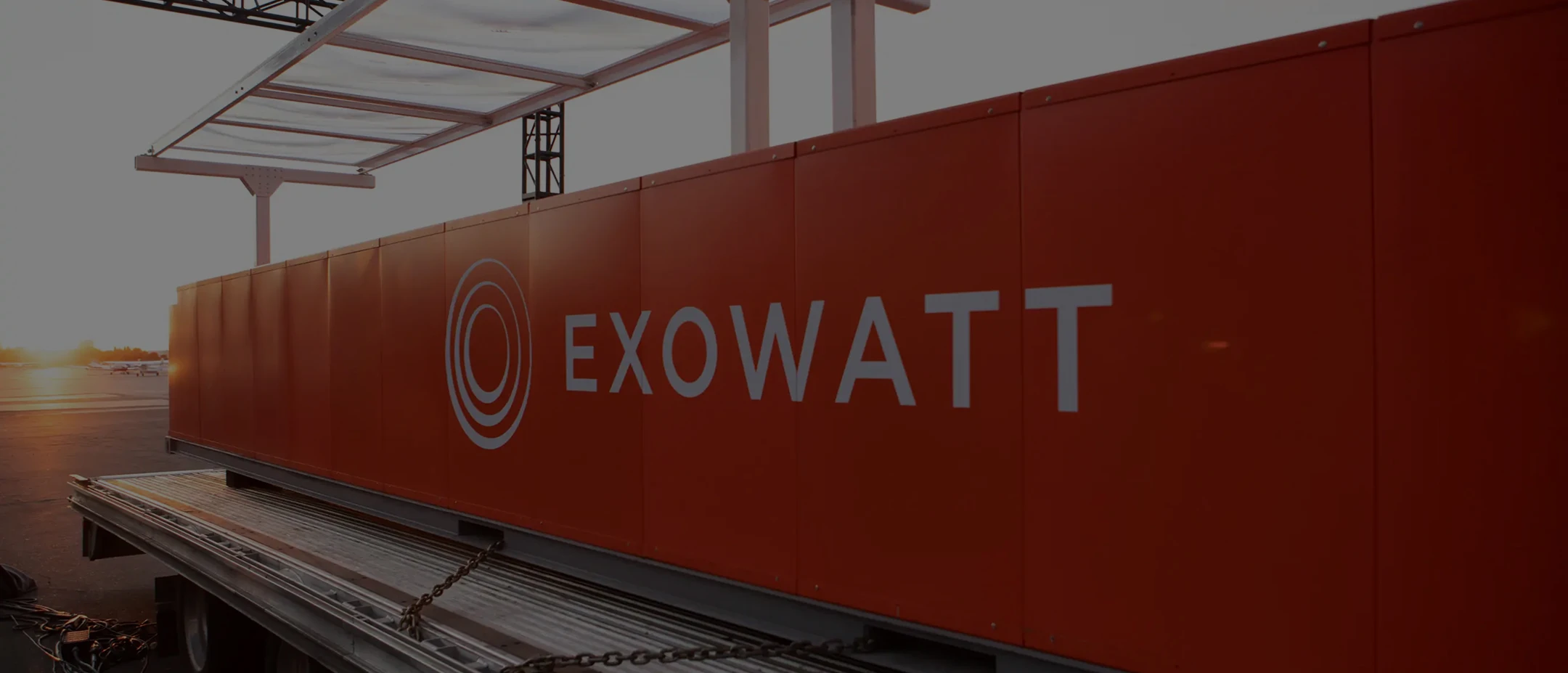
Exowatt’s P3 unit is a metal box topped with lenses that concentrate sunlight onto a high‑temperature brick. Air moves the heat to a Stirling engine and generator. Multiple P3s feed one generator; additional units increase storage and output. The company says each thermal battery can retain usable heat for up to five days, enabling 24/7 operation through night and intermittent cloud.
The extension was led by MVP Ventures and 8090 Industries with participation from Atomic, BAM, Bay Bridge Ventures, DeepWork Capital, Dragon Global, the Florida Opportunity Fund, Massive VC, New Atlas Capital, Overmatch, Protagonist, and StepStone. Exowatt cites a backlog of ~10 million P3 units representing ~90 GWh of capacity and argues that scaling a small, repeatable module will unlock PV‑like learning curves absent from conventional concentrated solar power (CSP) megaprojects.
Why This Matters Now
AI buildouts are running into power walls. A 100,000‑GPU cluster can draw 70-100 MW before cooling; at a typical PUE of ~1.2, site demand can exceed 80–120 MW. Round‑the‑clock, carbon‑free electricity today is often stitched together from wind, solar, storage, and market purchases at 7–15¢/kWh. If Exowatt can truly deliver firm power at 1¢/kWh in high‑insolation regions, the energy portion of AI training and inference costs could fall materially-improving unit economics and enabling new sites where the grid is constrained.
Numbers That Need Scrutiny
Backlog math: Exowatt cites 10 million units equaling ~90 GWh of capacity-roughly 9 kWh per unit. If accurate, supplying a 100 MW data center for 24 hours (~2,400 MWh) would require on the order of 260,000+ units for storage alone, plus additional collectors for daytime generation. That is a nontrivial land and logistics footprint. The company may be describing thermal, not electric, energy; either way, operators should request a unit‑level spec sheet with clear electric energy and power ratings, conversion efficiency, and thermal losses over multi‑day storage.
Technology risk: Stirling engines have seen reliability and maintenance challenges in prior dish‑Stirling CSP attempts. Optical systems demand regular cleaning, especially in dusty, high‑DNI deserts. Thermal-to-electric efficiency, degradation rates, and O&M cost profiles need independent validation. Exowatt’s cost target is contingent on ~1M units/year—a steep manufacturing ramp that may take years.
Siting realities: To deliver constant output from daytime solar, systems are typically overbuilt by ~3x nameplate capacity to charge storage for night hours. Land use for 100–200 MW 24/7 could span hundreds to low thousands of acres depending on design and DNI. Permitting considerations include glare, local zoning, noise/vibration from engines, and FAA review near airports. Water-light or dry cleaning strategies must be proven to control O&M.

Competitive Context
Incumbent pathways to 24/7 clean power include: PV plus multi‑hour batteries (mature, ~4–10¢/kWh for firmed portfolios in practice), enhanced geothermal (e.g., Fervo; promising where resource exists), long‑duration storage (iron‑air from Form, flow batteries, liquid metal), and nuclear (including SMRs, but timelines and capex are uncertain). In thermal storage specifically, Antora uses carbon blocks with thermophotovoltaics to produce electricity; Rondo focuses on industrial heat. Prior CSP efforts (e.g., tower and trough plants) have struggled with capex and O&M—Crescent Dunes’ issues remain cautionary. Exowatt’s differentiation is modularity and a manufacturing‑first learning curve; proving that at scale is the hurdle.
Operator’s Perspective: What This Changes
If Exowatt achieves anywhere near its target costs, greenfield data centers in high‑insolation regions (U.S. Southwest, MENA, Australia) could deploy behind‑the‑meter firm power with lower energy prices and reduced grid dependence. That could accelerate site approvals, de‑risk interconnection queues, and improve 24/7 CFE scores. If costs land closer to today’s firm renewable portfolios (≥6–10¢/kWh), P3 could still be viable as a hedge or hybrid paired with PV and grid purchases.
Recommendations
- Run a gated pilot: Commission a 1–5 MW pilot in a high‑DNI location with independent M&V of capacity factor, round‑trip efficiency, O&M cost, and availability. Tie payments to performance guarantees.
- Model land and logistics: Require a detailed layout showing unit count, acreage, access roads, cleaning systems, and spare parts. Validate noise and glare studies for permitting.
- Stress‑test the economics: Request a pro forma LCOE at your latitude with conservative assumptions (engine availability, cleaning labor, insurance). Compare against PV+storage and geothermal options.
- Plan hybridization: Treat P3 as a component of a 24/7 portfolio. Combine with PV, grid, and long‑duration storage to smooth weather variability and maintenance outages.
- Governance and accounting: Align with 24/7 CFE accounting frameworks and ensure safety compliance for high‑temperature systems. Confirm interconnection requirements for backup and export.
Bottom line: the vision—factory‑scaled, modular solar‑thermal delivering ultra‑cheap firm power—is compelling and well‑timed. The burden of proof is unit‑level performance, durability, and true all‑in costs at scale. If Exowatt clears those hurdles, it could meaningfully reshape where and how AI power gets built.
Leave a Reply