Quantinuum Helios: Ion-based quantum leap cuts error overhead and accelerates enterprise pilots
Quantinuum’s new Helios quantum computer signals a step-change in hardware efficiency: 98 barium-ion qubits, on-the-fly error correction, and a two-to-one physical-to-logical qubit ratio-dramatically lower overhead than leading superconducting systems. For executives, this narrows the gap between R&D prototypes and practical pilots for chemistry, materials, and complex optimization-while full commercial payoff remains several years out.
Executive Summary
- Lower error overhead = more useful computation per qubit. Helios achieves a 2:1 physical-to-logical qubit ratio and 99.921% entanglement fidelity, enabling deeper circuits with fewer resources.
- Cloud-accessible and GPU-assisted error correction. Real-time error correction on Nvidia GPUs makes integration with existing HPC/AI stacks more straightforward.
- Road map clarity for planning. Helios today, Sol in 2027 (192 qubits), and Apollo in 2029 (targeting fully fault-tolerant thousands of qubits) informs multi-year investment timing.
Market Context: Competitive landscape shifts toward ions
Helios, located in Colorado with a second unit planned for Minnesota, leverages trapped-ion qubits with all-to-all connectivity-ions can be moved to interact with any other qubit—reducing routing overhead common in superconducting devices. “Helios is an important proof point in our road map about how we’ll scale to larger physical systems,” said Jennifer Strabley, VP at Quantinuum. Independent physicist Rajibul Islam (University of Waterloo) called Helios’s precision noteworthy, citing 99.921% two-qubit entanglement fidelity. Compared with recent superconducting demonstrations—Google (~105 physical per logical), IBM (~12), and AWS (~9)—Helios’s 2:1 ratio highlights a potential cost/performance edge in error management.
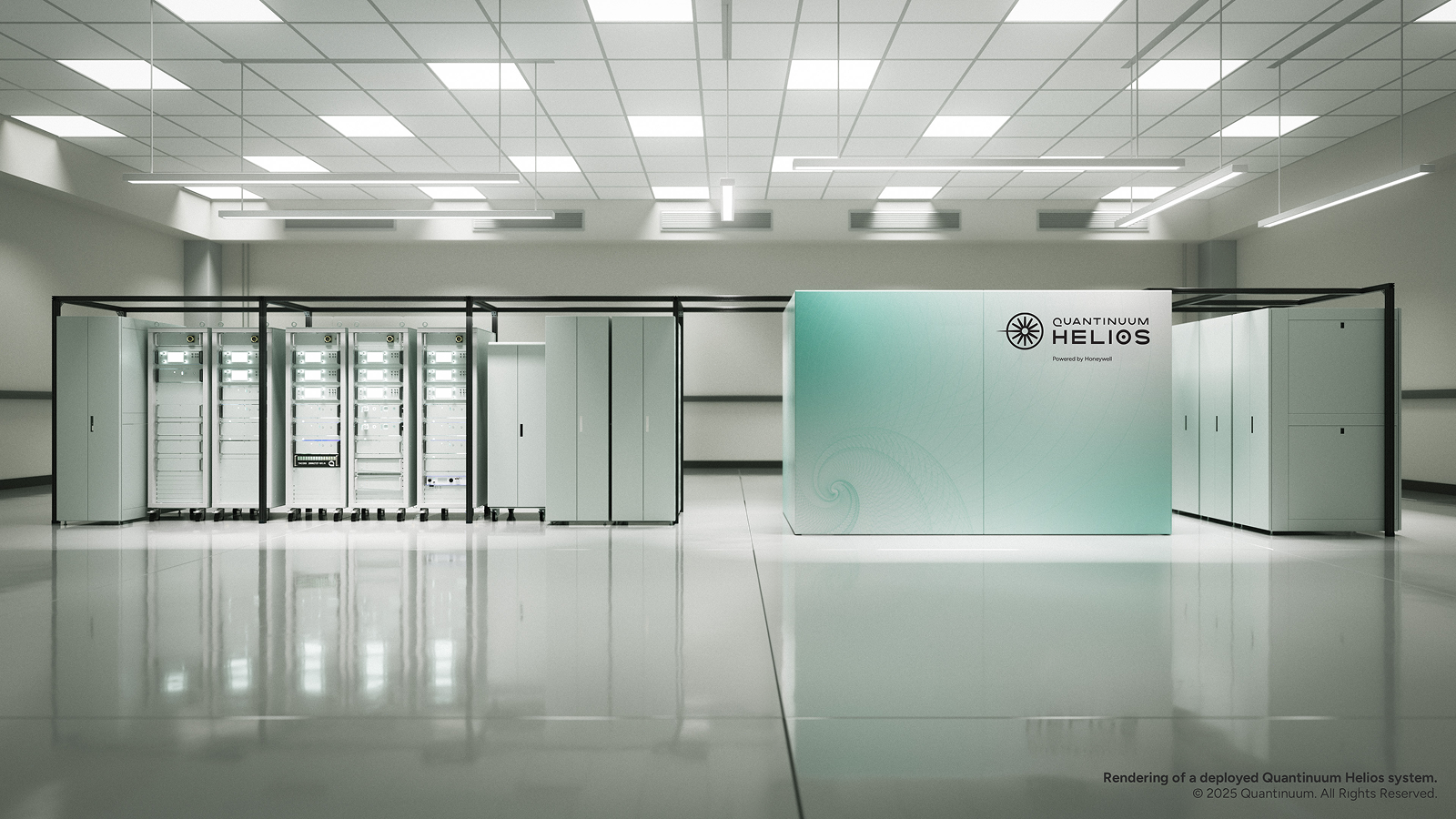
Still, there is no settled “winner.” Superconducting qubits scale via mature fabrication; neutral atoms (e.g., QuEra) are easier to trap; ions (Quantinuum, IonQ) tend to have lower base error rates. Quantinuum’s on-the-fly error correction—implemented with Nvidia GPUs—adds a pragmatic enterprise angle by aligning with existing GPU-centric infrastructure, noted David Hayes, Quantinuum’s director of computational theory and design.

Opportunity Analysis: Where early value may emerge
Near term (12-24 months): targeted pilots. Higher qubit fidelity and reduced overhead make Helios suitable for constrained but meaningful workloads—variational chemistry for battery materials, catalytic design hypotheses, and hard optimization heuristics for logistics and portfolio construction. Quantinuum’s recent physics simulations (magnetism, superconductivity) indicate growing scientific relevance—an early signal for materials and energy players. Government interest (e.g., U.S. Department of Energy topics) points to grant and co-development pathways.

Mid term (2027-2029): roadmap-driven bets. If Sol (2027) and Apollo (2029) arrive on schedule—with thousands of qubits and practical fault tolerance—workloads could shift from proofs of concept to production-adjacent accelerators in quantum simulation and complex optimization. Firms that build domain models, data pipelines, and hybrid HPC+quantum workflows now will be positioned to capture time-to-solution advantages as hardware matures.
Action Items: Moves to secure strategic advantage now
- Run a 90-day cloud pilot on Helios: benchmark one chemistry or optimization use case against your current HPC baselines to quantify circuit depth and accuracy gains.
- Stand up a hybrid workflow: integrate GPU-based error correction/logging into your MLOps/HPC stack to streamline experimentation and data capture.
- Co-develop with experts: partner with Quantinuum and academic labs (e.g., DOE-aligned programs) to access algorithms and funding mechanisms.
- Build a quantum readiness squad: upskill a small cross-functional team (HPC, data science, domain R&D, security) and set a 2-3% exploratory budget.
- Set milestone gates: tie investment to Quantinuum’s roadmap (Helios today, Sol 2027, Apollo 2029); revisit business cases at each hardware inflection.
- Address governance early: assess IP, data residency (U.S.-based systems), and vendor risk; codify success metrics (accuracy, cost-per-insight, time-to-result).
Leave a Reply