Executive Hook: A $60M signal-and a boardroom blind spot
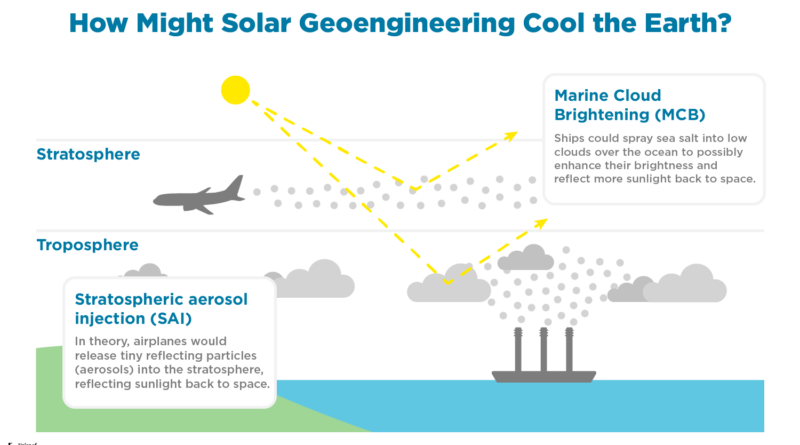
Stardust, an American-Israeli startup claiming proprietary particles to reflect sunlight, just raised $60 million-the largest known venture round in solar geoengineering. Add early movers selling “cooling credits” and new entrants promising localized aerosol cooling, and a once-hypothetical technology is inching from fringe to funded. For corporate leaders, this is not a curiosity. It’s a material strategy question: Do you engage, oppose, or ring‑fence? The wrong call could saddle you with unpriced liabilities, reputational shocks, and governance crises that overwhelm any speculative climate payoff.
Industry Context: Profit is colliding with a governance vacuum
Scientists increasingly caution that sunlight reflection methods (SRM) carry profound uncertainties, from stratospheric chemistry to precipitation shifts and ozone impacts. MIT Technology Review’s guest commentators-longtime SRM researchers—argue that research should be publicly coordinated, transparently funded, and governed multilaterally. Today there is no binding international regime defining who decides, who pays, and who is liable. Patchworks of environmental law, airspace and export controls, and soft‑law norms (e.g., precautionary positions under biodiversity frameworks) leave gaping legal gray zones. Into that vacuum, venture capital is now flowing.
I’ve sat with boards through other “cheap, scalable, cross‑border” waves—crypto, drones, gene editing. The pattern rhymes: low direct costs, high systemic downside, and governance lag. SRM is that pattern on planetary scale. Businesses that misread this turn a science debate into a balance‑sheet problem.

Core Insight: Asymmetric downside + missing rules = a poor bet
SRM’s touted “affordability” hides risks markets won’t price until after damage occurs. The science allows modeling of potential cooling; it cannot assure equitable, reversible, or litigably defensible outcomes across borders. The commercial incentives—intellectual property, speed to market, revenue pressure—conflict with the transparency and consensus needed to sustain public trust. That is why the private rush is not merely premature; it is structurally misaligned with the only condition under which SRM could ever be considered: legitimate, multilateral governance backed by open science and societal consent.
Put bluntly: the near‑term financial upside is capped, while tail risks—ecological, geopolitical, legal, and reputational—are uncapped. That is not a climate strategy; it is an enterprise‑risk amplifier.
Common Misconceptions that Mislead Boards
- “Cheap equals rational.” Direct deployment costs can be low; liabilities are not. Cross‑border nuisance claims, human‑rights litigation, and investor suits for misleading environmental claims can dwarf any near‑term revenue.
- “Private capital accelerates responsible science.” In SRM, profit motives skew research toward proprietary claims, suppress null results, and erode transparency—precisely what public trust requires.
- “We can localize or do ‘small’ trials.” Atmospheric systems are coupled; even “limited” experiments can create attribution fights and diplomatic friction. You cannot sandbox the sky.
- “Safer particles solve the problem.” Stratospheric chemistry is complex. Claims of inertness or ecosystem safety are disputed by domain experts, and unknowns persist even for better‑studied sulfates.
- “We can switch it off.” Abrupt cessation after prolonged use risks “termination shock”—a rapid temperature spike with severe impacts, creating technological lock‑in and moral hazard.
- “Regulatory arbitrage protects us.” Governance gaps cut both ways: they invite sudden moratoria, export controls, insurance exclusions, and retroactive liability once harms or scandals surface.
Strategic Framework: The T.R.U.S.T. Test for SRM Exposure
- Transparency: Is the science open, peer‑reviewed, and reproducible—with data, methods, and adverse findings disclosed? If not, assume heightened legal and reputational risk.
- Red Lines: Has your board defined explicit no‑go thresholds (e.g., no funding or commercialization absent multilateral authorization and independent oversight)? Without red lines, hype fills the void.
- Universal Governance: Does a binding, internationally recognized framework exist that allocates decision rights, monitoring, and liability? If not, do not treat SRM as investable or bankable.
- Societal Consent & Justice: Have affected communities—especially in the Global South—been meaningfully engaged with the power to dissent? Lack of consent transforms risk into conflict.
- Termination Plan: Is there a credible, funded exit pathway that avoids termination shock and tech lock‑in? If you can’t stop safely, you shouldn’t start.
Run any SRM‑adjacent opportunity through this test. Most will fail today. That’s the point.
What Most Companies Overlook in Their Risk Models
- Liability without borders: Transboundary harm doctrines and evolving human‑rights due diligence rules extend risk across jurisdictions—even if activities occur offshore or via vendors.
- Uninsurable exposures: Carve‑outs for pollution, intentional acts, and gradually emerging harms can leave D&O, general liability, and project policies ineffective.
- Securities and advertising risk: Aggressive climate claims invite regulator scrutiny and investor litigation if technical assertions later prove inaccurate or incomplete.
- Policy whiplash: A single high‑profile incident can trigger emergency bans, export controls on aerosols/dispersion tech, and listing restrictions by exchanges or lenders.
- Trust deficit: Civil society, Indigenous groups, and Global South governments are predisposed to skepticism. Absent procedural legitimacy, even benign activity faces backlash.
Action Steps: What leaders should do Monday morning
- Set posture: Adopt a board resolution stating the company will not fund, procure, or market SRM deployment or “cooling credits” absent multilateral authorization and independent public oversight.
- Governance & oversight: Assign your General Counsel and Chief Risk Officer to co‑chair an SRM working group with external scientific advisors and ethicists. Report to the board’s risk committee quarterly.
- Portfolio hygiene: Add SRM to investment exclusion lists and M&A due diligence checklists. Screen vendors for geoengineering activity; insert contract clauses prohibiting SRM services.
- Science integrity policy: Require open science commitments, preregistration of studies, and peer review for any funding of climate‑modification research. No proprietary “black box” claims.
- Scenario planning: War‑game three shocks—(1) alleged precipitation impact event, (2) regulatory moratorium, (3) activist campaign against SRM ties. Stress‑test liquidity, insurance, and comms.
- Insurance review: Engage brokers now on SRM exclusions and potential endorsements. Assume limited coverage; price self‑retention and contingent liabilities.
- Stakeholder engagement: Consult frontline and Indigenous communities where your operations could be implicated by SRM debates. Document grievance mechanisms and consent processes.
- Policy stance: Publicly support transparent, publicly coordinated research under academic consortia, not commercial deployment. Advocate for international governance before any use.
- Refocus capital: Prioritize proven mitigation and adaptation—efficiency, renewables, storage, grid flexibility, nature‑based resilience—where ROI is real and risk is bounded.
The venture dollars flowing into SRM will tempt some to frame it as “pragmatic.” It isn’t. Until there is legitimate, enforceable global governance—and hard evidence that benefits outweigh risks across societies—SRM remains a reputational hazard and a legal minefield. The smarter play isn’t to ignore it; it’s to set firm red lines, back transparent public research, and double down on decarbonization and resilience where markets and societies have already built trust.

That is how you protect your license to operate in a warming world—without betting the brand on stardust.
Leave a Reply