AI Readiness Checklists As Power Maps In Enterprise Transformation
THE CASE
In late 2024, a global retail and consumer banking group launched what it called an “enterprise AI readiness checklist: data, skills, and governance for 2026 deployments.” The board had set an ambition that by the start of 2026, at least half of customer interactions would be “AI-supported” and at least three core processes would use AI for real economic impact: credit decisioning, contact center operations, and financial crime detection.
The chief AI officer, newly hired from a cloud vendor, commissioned a cross-functional task force to define what “ready” meant. Over three months, they produced a 220-line spreadsheet covering data foundations (lineage, quality, consent, retention), skills (modeling, MLOps, prompt engineering, business product ownership), and governance (EU AI Act alignment, model risk management, human-in-the-loop controls).
Each business unit was scored red, amber, or green on every line. A public dashboard showed that by mid-2025 the bank was “63% AI-ready” for its 2026 targets. Slides circulated to the board and regulators describing a disciplined, phased transformation. Externally, the bank was hailed at conferences as a model of responsible scaling of generative AI.
Inside the organization, the picture looked different. Marketing leaders pushed for “green” ratings to unlock budget and headcount. Risk and compliance, suddenly responsible for interpreting upcoming AI regulations, insisted that any system touching lending or fraud be classified as “high-risk,” triggering extra controls and months of review. The data platform team, already overloaded with cloud migrations, quietly set quality thresholds so strict that almost no legacy dataset qualified as “ready.”
By the end of 2025, most of the investment had flowed into documentation exercises, data catalog clean-up, and governance committees. The only AI system widely deployed to production was an internal knowledge assistant for employees. On paper, the bank approached 80% readiness. In practice, its flagship customer-facing AI projects were two years behind schedule and increasingly constrained by its own checklist.
THE PATTERN
This bank’s experience is not an anomaly; it reveals a structural pattern in how large organizations now use “AI readiness” as a coordination device. In theory, a readiness checklist is a neutral way to sequence investments: fix data, grow skills, install governance, then deploy AI at scale. In practice, it becomes a living map of power, fear, and aspiration inside the enterprise.
The first pattern is that AI readiness checklists sit at the intersection of three deep systems that rarely align neatly: data infrastructure and ownership, human capabilities and career ladders, and governance and regulatory exposure. Each of these already has its own history and politics. Compressing them into a single artifact forces trade-offs about whose priorities count as “readiness.”
Data teams view the checklist as leverage to finally rationalize decades of fragmented systems. They translate every AI use case into arguments for better catalogs, lineage, and master data. Risk and legal functions see it as a shield against incoming obligations such as the EU AI Act and sector-specific guidelines, pushing to classify more systems as regulated and to formalize model risk management. Business line owners treat the checklist as a budget gateway: a way to justify AI programs to the CFO or, conversely, to stall threatening automation by emphasizing red flags.

Underneath, three illusions take hold. The inventory illusion suggests that if an organization can list its datasets, models, and skills, it is halfway to being AI-ready. The ownership illusion presumes that each key asset (a dataset, a workflow, a risk) has a clear single owner who can sign off. The stability illusion assumes that the technology landscape and regulatory expectations will remain sufficiently stable between 2024 and 2026 that today’s checklist will still be relevant at deployment time.
These illusions make the checklist legible to executives and boards, which crave static snapshots and scores. Yet AI, especially foundation-model-based systems, evolves on quarterly cycles, and regulations are tightening on a similar tempo. What starts as a readiness framework quickly gains a second role: it freezes a moving target into a set of bureaucratic commitments that are hard to revise without organizational friction.
The deeper structural insight is that AI readiness checklists are “boundary objects” between tribes that do not fully trust one another. Engineers, lawyers, regulators, product managers, and operations teams each read the same rows and columns through their own lenses. A column titled “human oversight” means workflow latency to product; accountability to legal; and staffing headaches to operations. The checklist does not resolve these tensions; it surfaces and stabilizes them in a form that can be reported upward.
As a result, the checklist’s main impact is not on whether an enterprise can technically deploy AI in 2026. It primarily reshapes internal power: who authorizes what, whose risk assessments matter, which data becomes strategic, and where new AI-related headcount is allocated. The bank’s 220-line spreadsheet functioned less as a project plan and more as an emergent constitution for how AI would be governed.
THE MECHANICS
The way this pattern plays out is driven by a set of overlapping incentives, constraints, and feedback loops that are broadly similar across large enterprises preparing AI deployments for 2026.
Incentives. Senior executives want to demonstrate strategic modernity to boards, investors, and regulators. A high, steadily improving readiness score offers visible proof that the organization is not “behind on AI.” Consultants and vendors benefit from frameworks that translate into assessment projects, platform migrations, and training programs. Data and ML teams gain leverage to secure infrastructure investments when they can point to gaps in the checklist. Risk, legal, and audit functions gain influence by controlling gates on “high-risk” systems. HR and learning teams see AI skills gaps as mandates for expansive reskilling initiatives.
Constraints. Meanwhile, legacy estates, regulatory timelines, and talent shortages set hard limits. Many organizations still run critical workflows on mainframes or highly customized enterprise systems where integrating modern AI is non-trivial. Cloud contracts and vendor commitments signed in the pre-generative-AI era constrain architecture choices. Externally, regulations such as the EU AI Act, sectoral supervisory expectations, and emerging standards like the NIST AI Risk Management Framework and ISO/IEC 42001 create new documentation and control requirements that must be met by 2026. The supply of people who truly understand data architecture, model evaluation, and AI risk management remains thin relative to demand.
Feedback loops. Once a readiness checklist is codified, it becomes a management instrument. Business units are benchmarked and compared. Leaders start optimizing for the metric rather than for actual safe and effective AI deployment. Low scores become arguments for more budget or for deferring ambitious AI projects. High scores become political capital, even when they reflect generous interpretations of the criteria.
Every visible AI misstep-a public hallucination incident, a biased model uncovered by auditors, a privacy scare-tends to produce a governance reflex. New rows are added to the checklist, additional approvals are required, and thresholds for “green” are raised. Each tightening is rational on its own terms but collectively slows down the deployment pipeline. Some teams respond by running “shadow AI” experiments outside official processes, often using third-party foundation models with minimal controls, further increasing risk and reinforcing calls for central gatekeeping.
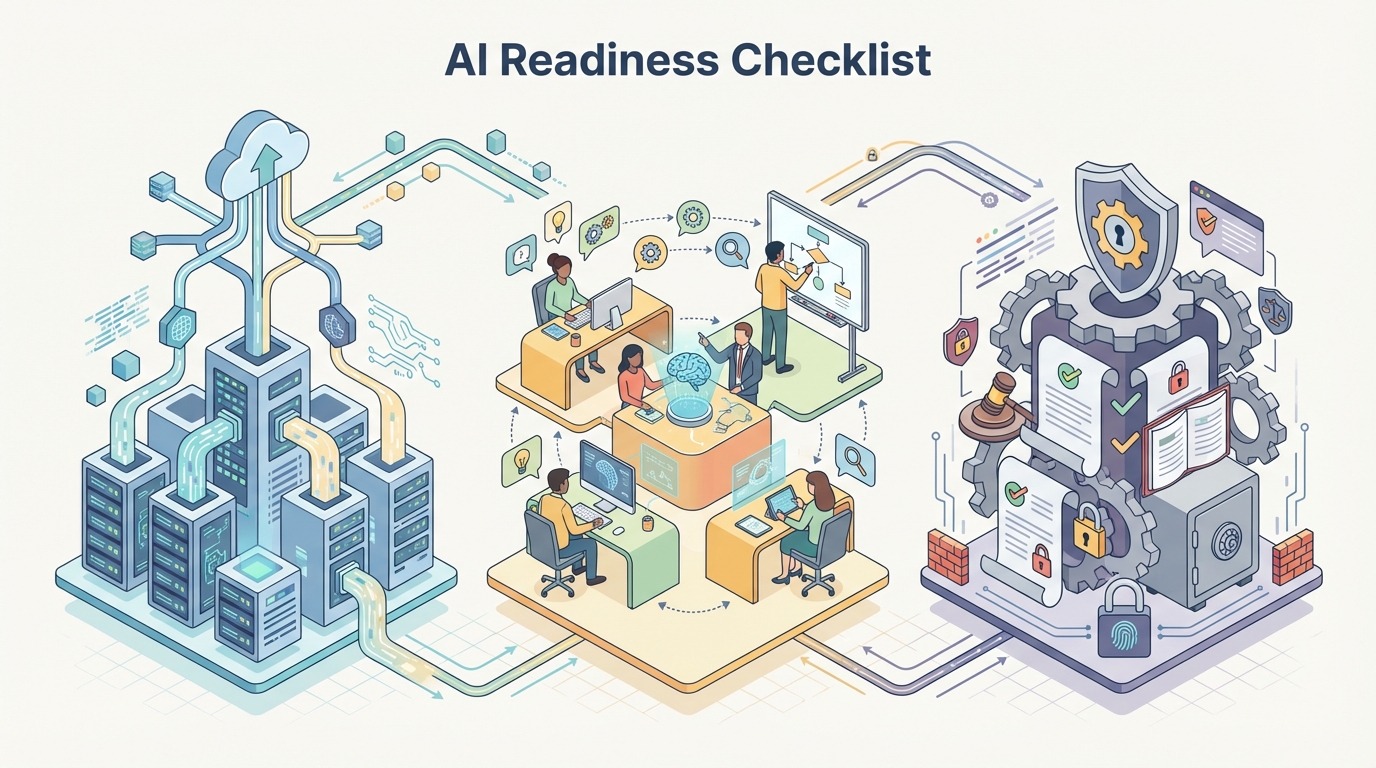
The three pillars of the enterprise AI readiness checklist interact in distinctive ways.
On the data side, readiness efforts often trigger overdue clean-ups: consolidating CRM systems, enforcing data contracts, and clarifying consent. Yet they can also centralize authority in platform teams that become bottlenecks. Ownership disputes emerge when business units realize that whoever “owns” a dataset under the checklist’s definitions controls which AI products can be built on top of it.
On the skills side, organizations rush to stand up “AI academies” and “prompt engineering” boot camps. These help create a veneer of literacy, but they often bypass deeper competencies such as robust experimentation, error analysis, evaluation design, and socio-technical impact assessment. Real readiness depends on embedding those scarcer skills into product and operations teams, not just on counting course completions. Yet the checklist tends to measure the latter, because it is more easily quantified.
On the governance side, new bodies proliferate: AI councils, ethics boards, model risk committees. RACI matrices are drawn; policy documents are published. Whether these structures meaningfully shape systems early in their design or merely review them at the end becomes a critical determinant of actual deployment speed. If governance is concentrated late in the process, it functions as a veto gate. If it is integrated into design, it can identify risks while there is still room for architecture and product choices to adapt.

The decisive mechanical feature is ownership of the checklist itself. When the CIO or data office owns it, the focus tilts toward platforms and standards. When the CISO or risk office owns it, constraints and approvals dominate. When a digital or product leader holds the pen, the checklist emphasizes customer journeys and measurable outcomes. In each case, the organization reads the same words but experiences a different AI transformation because the checklist encodes a particular function’s worldview.
THE IMPLICATIONS
Once AI readiness checklists are understood as power maps rather than neutral project plans, several aspects of the next two years of enterprise AI become predictable.
Enterprises that treat readiness as a sociotechnical negotiation are more likely to reach meaningful 2026 deployments. In those organizations, the checklist becomes a starting point for redesigning data ownership, product governance, and accountability, not an end-state scorecard. Expect them to move toward product-aligned data domains, federated AI governance, and cross-functional teams where data, engineering, risk, and operations share objectives instead of throwing artifacts over functional walls.
Enterprises that treat readiness primarily as a compliance ritual will generate impressive dashboards and white papers while struggling to move beyond pilots. Their 2026 stories will emphasize the robustness of governance frameworks, the volume of training delivered, and the completeness of their model inventories, but their core value streams will remain largely unchanged. AI will live at the edges-knowledge assistants, coding copilots, internal productivity tools—while high-stakes processes remain untouched or only lightly augmented.
Across both groups, new roles and structures will become common by 2026: heads of AI governance, AI product owners embedded in business lines, enlarged model risk teams, and AI operations units distinct from traditional IT. The specific titles will vary, but the direction is clear. Authority over data, skills, and governance will be redistributed, and the checklist will be one of the main artifacts through which that redistribution is negotiated.
Finally, external observers—investors, regulators, partners—will learn to read AI readiness claims as signals about internal alignment rather than pure measures of technical maturity. An enterprise that can explain how its checklist evolved, which functions contributed, and how trade-offs were made is likelier to deliver durable AI systems by 2026 than one that simply reports a high readiness percentage. In that sense, the most valuable output of the enterprise AI readiness checklist is not the score it produces, but the organizational self-knowledge it forces into the open.
Leave a Reply