What Changed and Why It Matters
Meta rolled out Facebook Content Protection, a mobile tool that detects when a creator’s original Reels are reused without permission and lets creators block distribution across Facebook and Instagram, track performance, add attribution links, or release claims. Access is currently limited to creators in Meta’s monetization programs and Rights Manager users, and protection only activates if the Reel is posted to Facebook (including via Instagram’s “Share to Facebook” cross-posting). For operators, this is a concrete shift toward platform-level enforcement for short-form video-important in a market where original content is routinely copied and reposted.
This matters because attribution and control are prerequisites for reliable creator monetization. Meta says it has recently removed about 10 million accounts impersonating major creators and taken action against roughly 500,000 accounts for spam or fake engagement. This tool aims to convert takedown work into a scalable workflow that gives creators daily control rather than sporadic enforcement.
Key Takeaways for Executives
- Protection is Reels-first and Facebook-dependent: Reuse is detected only if the original Reel exists on Facebook (cross-posting from Instagram qualifies).
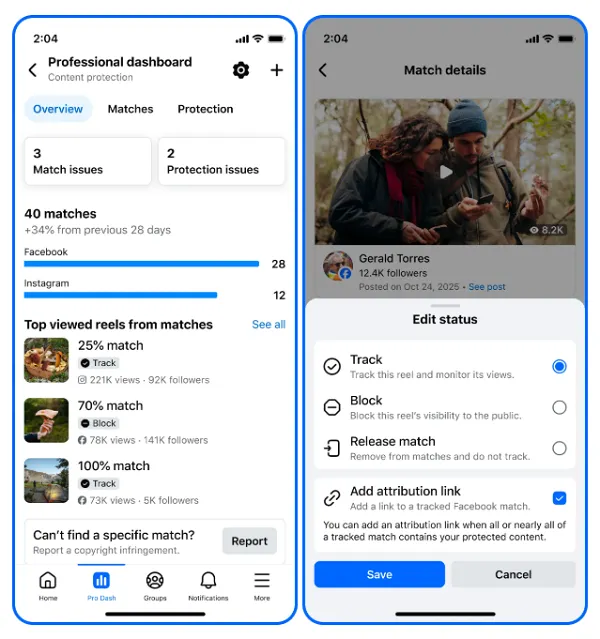
- Actions include block (limits distribution on FB/IG), track (default), and add attribution links that label content as “original” and drive viewers back to the source.
- No automatic penalties for infringers when a block is applied; deterrence comes from reduced distribution, not creator strikes.
- Available to creators in Meta’s Content Monetization program who meet integrity/originality standards and to Rights Manager users; eligibility appears in the Professional Dashboard under “Content Protection.”
- Abuse controls exist: allow lists for licensed partners, and misuse can lead to creator restrictions or loss of tool access.
Breaking Down the Announcement
The tool centralizes reuse detection and case handling on mobile, where most Reels workflows happen. Creators can: (1) block visibility across Facebook and Instagram, (2) track performance of reposts and optionally add attribution links that label the origin and point to the creator’s profile/page or original Reel, or (3) release the claim so the repost remains visible. The default policy is “track,” lowering the risk of over-blocking while creators calibrate settings.
Operationally, allow lists are key. If a brand partner or collaborator has licensed your clip, you can whitelist their account so their uploads aren’t flagged. If someone else tries to protect your work, you can dispute via Meta’s IP reporting channel (i.e., a copyright takedown). Meta hasn’t detailed the detection method, but systems of this type typically use perceptual hashing and video fingerprinting to find near-duplicates.
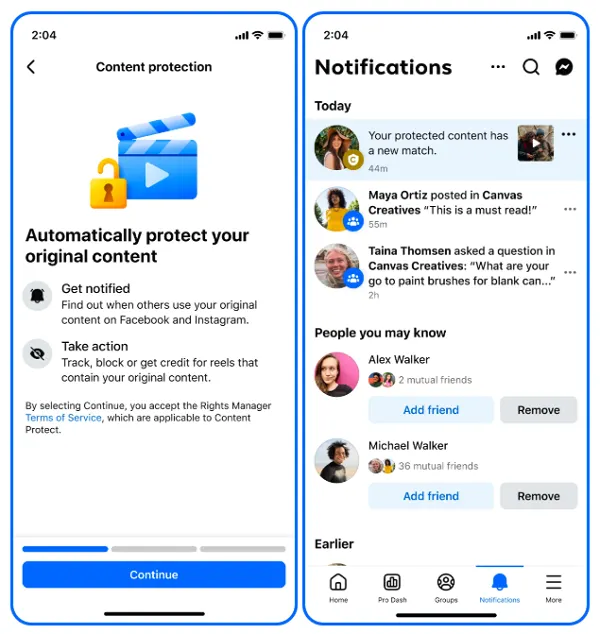
The catch: the system only tracks content you’ve posted to Facebook. If you publish on Instagram but don’t cross-post, or you publish only on other platforms, protection won’t trigger. This nudges creators and publishers to include Facebook in their distribution plans if they want full protection across Meta’s ecosystem.
Competitive Context
Compared with YouTube’s Content ID, Meta’s approach is narrower. YouTube allows rights holders to apply policies that block, track, or monetize matched uploads, including redirecting ad revenue to the original owner. Meta’s new tool offers block and attribution but does not (at launch) redirect monetization on reposted Reels. TikTok has a mix of music-focused rights systems and creator attribution features, but cross-platform, creator-level protection for short-form video remains fragmented.
For brands and creator businesses, Meta’s move increases the relative ROI of publishing to Facebook by consolidating protection and attribution across Facebook and Instagram. that said, the lack of revenue redirection on unauthorized uploads means the primary benefit today is traffic recapture and reach protection, not direct monetization of unauthorized copies.
Governance, Risk, and Compliance
There are three operational risks to manage. First, false positives and fair use: commentary, criticism, and licensed uses could be flagged; allow lists and a “track first” default mitigate this, but teams need a review playbook. Second, deterrence: since blocked reposts don’t trigger account-level penalties by default, bad actors may continue to test the limits; meaningful deterrence still relies on takedowns through IP channels. Third, scope: protection doesn’t extend beyond Meta’s platforms or to all content types (it’s framed around Reels), so rights enforcement remains multi-platform.
What This Changes for Operators
Content and social teams can move enforcement closer to real time, on mobile, without opening separate rights systems. Attribution links and the “original” label can reclaim audience and followership that previously leaked to repost accounts. But you’ll need to adapt publishing and contracts: to gain protection, post to Facebook or cross-post from Instagram; codify who is allowed to repost; and decide when to block versus attribute to maximize discovery without rewarding free riders.
Recommendations
- Standardize cross-posting: Make Facebook publication (or Instagram “Share to Facebook”) part of your content release SOP so protection activates across Meta.
- Define policy templates: For short clips, default to “track + attribution” for discovery; for flagship or exclusive content, “block” by default. Review weekly and adjust.
- Build allow lists: Preload brand partners, editors, and affiliates to prevent false flags. Reflect these permissions in creator/brand contracts.
- Instrument outcomes: In the Professional Dashboard, track attribution-driven profile visits, follows, and watch time recovered from reposts. Tie to revenue metrics.
- Escalate strategically: Use content protection for speed; use formal copyright takedowns for repeat offenders or commercial misuse outside license terms.
What to Watch Next
Expect questions on whether Meta will add revenue redirection for unauthorized uploads, expand protection beyond Reels, and open eligibility to more creators. Also watch for improved transparency on match accuracy and potential API hooks so larger rights teams can manage claims at scale from existing tooling. If Meta closes those gaps, this could become a credible alternative to YouTube-style rights workflows for short-form video.
Leave a Reply